



Residual current monitoring and leakage protection
In EV charging applications, the on-board charger (OBC) contains complex power-conversion circuits. If insulation fails, the resulting leakage current may include not only conventional power-frequency AC, but also pulsating DC or smooth DC.
Why Type B detection is necessary
Conventional Type A residual-current protection devices may become ineffective because of magnetic saturation when exposed to DC leakage current. TheZDA13Aresidual-current monitoring sensor uses Type B technology to provide full-spectrum current monitoring:
- Smooth DC leakage current: monitors the 6 mA DC threshold to prevent DC components from interfering with upstream grid protection devices.
- Complex AC leakage current: monitors the 30 mA AC threshold to protect people against electric shock.
Implementation process
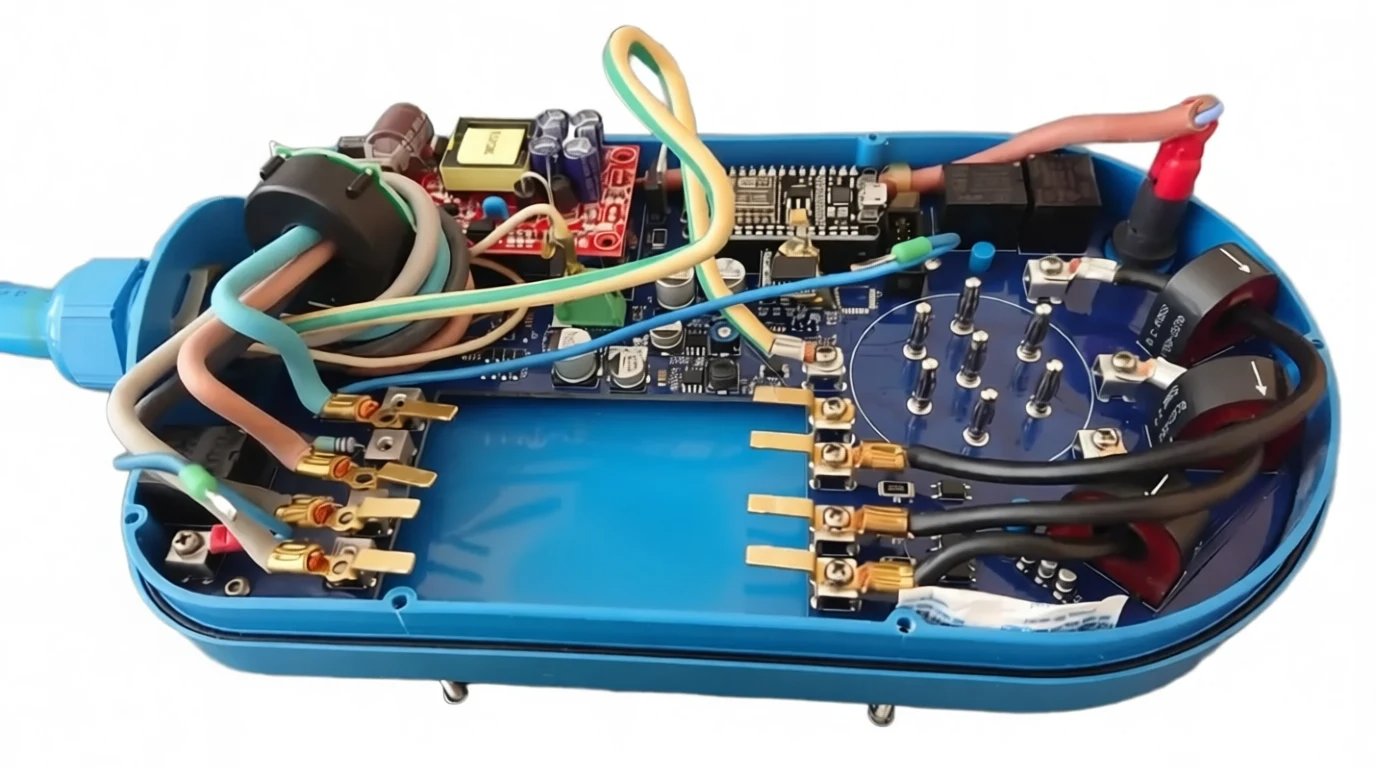
All live conductors in the charging station (L1/L2/L3/N) must pass through the ZDA13A sensing aperture together.
- Self-test stage: before charging starts, the main controller activates the ZDA13A built-in test function to confirm that the protection chain is intact.
- Monitoring stage: the vector sum of the currents in all conductors is calculated in real time. If the sum exceeds the safety threshold, the sensor immediately outputs a status signal.
- Protection stage: after receiving the signal, the main controller opens the contactor within milliseconds, creating closed-loop detection-feedback-disconnection protection.
Charging control and energy-metering sampling
To control the charging process precisely, the charging station must monitor the AC operating current in the main circuit in real time. This is a key application for theTA17precision current transformer.
Precision sampling and power control
The TA17 converts the high current in the main circuit into a low-level current signal at a 1:1000 ratio, providing the control system with highly linear (≤0.2%) data feedback.
- Dynamic adjustment: the controller adjusts the PWM signal in real time according to the sampled current, ensuring that charging power matches the vehicle requirements.
- Efficiency optimization: combined with voltage sampling, the system calculates active power and power factor to improve energy efficiency.
Energy-metering support
Although overall metering accuracy is affected by multiple factors, the TA17 serves as the front-end sensing element, and the high stability of its nanocrystalline core provides reliable raw data for energy billing.
Fault diagnosis and preventive maintenance
In addition to normal operating control, the current-detection system is also a key diagnostic tool for the charging station.
Overcurrent and short-circuit protection
If the TA17 detects that the current has instantaneously exceeded the rated range, the system can immediately apply software current limiting or hardware protection to prevent cable overheating or damage to power modules.
Contactor status monitoring
Working together, the ZDA13A and TA17 can diagnose mechanical faults in critical components:
- Contact-welding detection: if the controller has issued an open command but the TA17 still detects current, the system can identify welded contactor contacts, immediately trigger secondary protection, and report a fault code.
- Abnormal power-use alarm: detects abnormal small current fluctuations to help prevent electricity theft and identify risks from aging wiring.
Dual-channel collaborative electrical architecture
In practical charging-station designs, the ZDA13A and TA17 are not alternatives; they operate as complementary dual sentinels.
With this dual-channel design, a charging station can not only comply with international safety standards such as IEC 62752, but also improve the user experience and operation-and-maintenance efficiency through high-accuracy data acquisition.
An application-oriented current-detection solution requires engineers to address two dimensions: safety leakage-current monitoring and operating-current sampling. Combining a Type B sensor such as the ZDA13A with a precision current transformer such as the TA17 is one of the most effective approaches for enabling EV charging infrastructure to achieve high performance, high safety, and intelligent operation and maintenance.