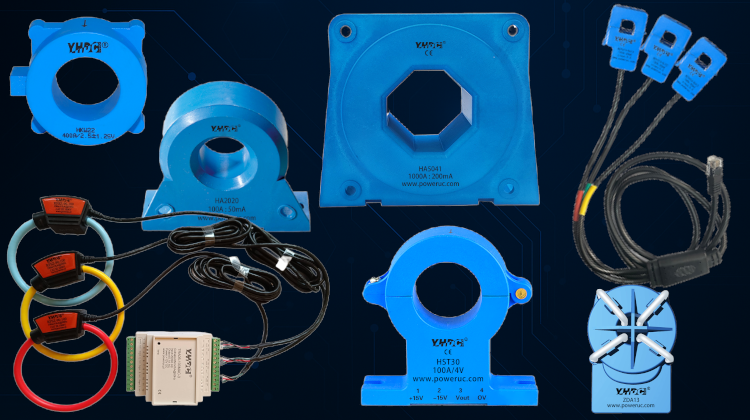
The difference in performance between current sensors may lie in this “magnetic core”
The magnetic core serves as the “sensing framework” of a current sensor; it concentrates the magnetic field generated by the current in the conductor and transmits it to the Hall effect sensor, coil, or magnetoresistive element for detection.
The quality of the magnetic core directly affects the sensor’s accuracy, linearity, temperature drift, saturation resistance, and frequency response.
I. Silicon Steel: A Established Solution for High-Power and Power Frequency Applications
Silicon steel is one of the fundamental soft magnetic materials. To reduce eddy current losses, 1% to 5% silicon is added to iron to increase resistivity.
- Core Advantages: High saturation magnetic induction (between 1.8T and 2.0T), low cost, and high mechanical strength.
- Performance Limitations: Losses increase sharply at high frequencies, therefore it is typically used below 1kHz.
- Applicable Scenarios: Power frequency current transformers, open-loop Hall current sensors.
II. Permalloy: Pursuing Ultimate Precision
Permalloy is a nickel-iron alloy with extremely high initial permeability and extremely low coercivity.
- Core Advantages: Extremely high sensitivity in weak magnetic fields, excellent linearity, and minimal phase error.
- Performance Limitations: Low saturation magnetic induction (approximately 0.7T–0.8T), and highly sensitive to mechanical stress.
- Applicable Scenarios: Precision current transformers, fluxgate current sensors, leakage current sensors.
III. Ferrite: An Essential Material for Switching Power Supplies
Ferrite is a type of ceramic magnetic material with extremely high resistivity.
- Core Advantages: High resistivity, extremely low eddy current loss at high frequencies, and working frequency can reach several MHz.
- Extremely low cost: Shape is easy to process.
- Performance Limitations: Low saturation magnetic induction strength (0.3T–0.5T), greatly affected by temperature.
- Applicable Scenarios: High-frequency current transformers, high-frequency open-loop sensors, Rogowski coils (auxiliary cores).
IV. Nanocrystalline: The “All-Rounder” in Soft Magnetic Materials
Nanocrystalline materials are manufactured through rapid solidification technology and possess extremely fine grain structures, combining the advantages of silicon steel and permalloy.
- Core Advantages: High saturation magnetic flux (~1.2T), high permeability, extremely low high-frequency loss.
- Temperature Stability: Minimal temperature drift, stable from DC to several hundred kHz.
- Performance Limitations: Material is brittle and usually requires a protective casing.
- Applicable Scenarios: Closed-loop Hall sensors, high-performance fluxgate sensors, wide-band current transformers.
Comparison table of performance of various magnetic core materials
| Characteristic | Silicon Steel | Permalloy | Ferrite | Nanocrystalline |
| Saturated magnetic field (Bs) | ~2.0T | ~0.8T | ~0.4T | ~1.2T |
| Initial permeability | Normal | Extremely high | Low | High |
| Frequency response | <1kHz | DC–100kHz | 50Hz–5MHz | DC–200kHz |
| Temperature stability | Good | Fair | Poor | Excellent |
| Linearity | Fair | Excellent | Fair | Good |
| Relative cost | Low | High | Very low | Medium |