

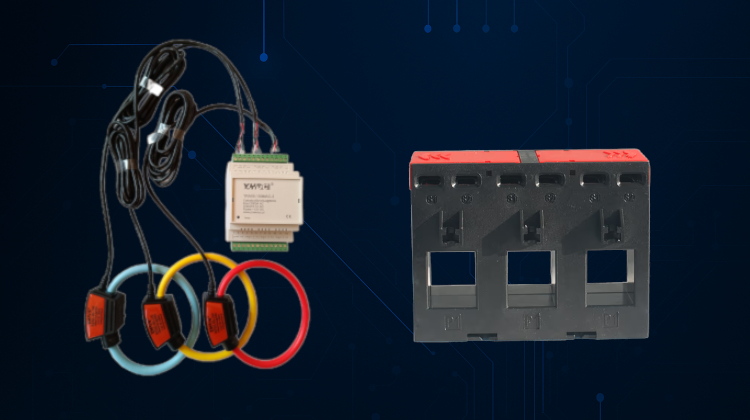
Operating current transformers (CTs) under overload conditions is forbidden because it severely impacts measurement accuracy, equipment integrity, and safety. While short-term overloads (up to 10 times the rated current) may be acceptable, sustained overloads can lead to a variety of serious failures.
Excessive primary current causes an increase in magnetic flux density, leading to core saturation. Once saturated, the relationship between the primary and secondary currents becomes nonlinear, resulting in waveform distortion and measurement errors. Overloading can also induce residual magnetism in the core, affecting the current and phase angle of the current transformer and reducing the accuracy of subsequent measurements.
Overloading increases the temperature of the windings. The heat generated by the windings is proportional to the square of the current (I²R loss); for example, a 10% overcurrent increases heat generation by approximately 21%. High temperatures accelerate the chemical decomposition of insulation materials. For every 6–8°C increase in temperature, the insulation’s service life is halved. Prolonged exposure to high temperatures can cause the insulation to melt, resulting in internal short circuits and ultimately leading to the complete burnout of the current transformer.
The dielectric strength of the insulating medium will decrease due to aging or damage caused by high temperature. Severe overheating or internal arcing faults may cause the current transformer to explode or ignite surrounding materials. In extreme cases, overload will cause the secondary circuit to open, which will cause the demagnetizing effect to disappear and the primary current to be completely converted into the excitation current, generating a peak voltage of several thousand volts at the secondary terminals, causing the risk of electric shock.




Copyright © 2026 PowerUC Electronics Co.